
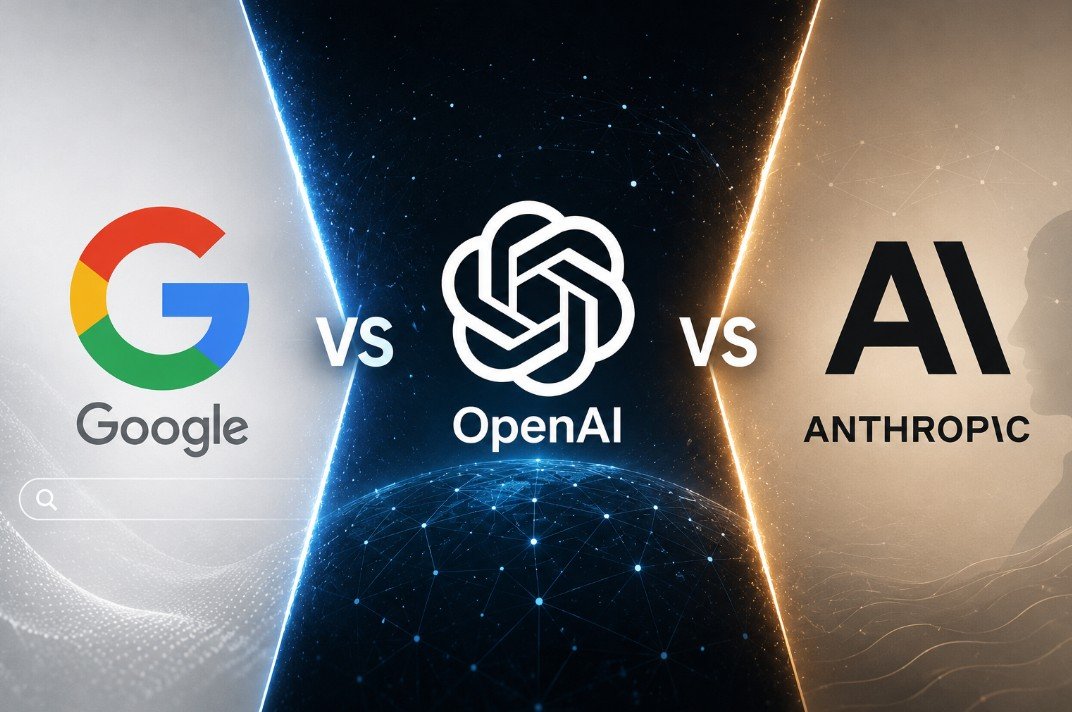
The artificial intelligence industry is evolving at an incredible pace. Every few months, a new model, feature, or breakthrough reshapes the competitive landscape. With OpenAI, Google Gemini, and Claude AI from Anthropic leading the market, many people are asking the same question: Who is actually winning the AI race?
The answer isn’t as simple as choosing a single winner. Each company has built impressive AI systems with unique strengths, and the competition continues to drive rapid innovation across the industry.
In this AI comparison, we’ll examine how these three tech giants stack up in 2026 and where each one shines.
OpenAI: Leading Through Innovation
OpenAI helped bring generative AI into the mainstream with ChatGPT, and it continues to be one of the industry’s biggest innovators.
Its ecosystem has expanded beyond conversational AI to include coding assistants, image generation, voice capabilities, business tools, and developer APIs. OpenAI also continues to invest heavily in AI agents that can perform increasingly complex tasks on behalf of users.
Strengths
- Excellent all-around performance
- Strong coding and programming assistance
- Powerful multimodal capabilities
- Large ecosystem for consumers and businesses
- Wide developer support
Best For
- Professionals
- Developers
- Content creators
- Businesses adopting AI at scale
Google Gemini: Built for the Google Ecosystem
Google has integrated Gemini across many of its products, including Search, Gmail, Docs, Sheets, Android, and Workspace.
Its biggest advantage is seamless integration with services millions of people already use every day. Google also continues to push the boundaries of multimodal AI, allowing users to work with text, images, audio, and video in a unified experience.
Strengths
- Deep integration with Google services
- Strong reasoning capabilities
- Excellent multimodal features
- Productivity-focused workflows
Best For
- Students
- Business users
- Google Workspace customers
- Everyday productivity
Claude AI: The Professional’s Assistant
Anthropic has positioned Claude AI as a powerful assistant for writing, reasoning, coding, and document analysis.
Many professionals appreciate Claude’s ability to handle lengthy documents while maintaining natural, thoughtful responses. Anthropic has also been emphasizing “agentic” AI—systems that can independently plan and complete multi-step tasks rather than simply answering questions. Recent releases reflect this growing focus.
Strengths
- Excellent long-form writing
- Strong document analysis
- High-quality coding support
- Natural conversational style
- Reliable business workflows
Best For
- Writers
- Researchers
- Lawyers
- Enterprise users
AI Comparison: Feature Overview
| Feature | OpenAI | Google Gemini | Claude AI |
|---|---|---|---|
| General Chat | ⭐⭐⭐⭐⭐ | ⭐⭐⭐⭐⭐ | ⭐⭐⭐⭐⭐ |
| Coding | ⭐⭐⭐⭐⭐ | ⭐⭐⭐⭐☆ | ⭐⭐⭐⭐⭐ |
| Writing | ⭐⭐⭐⭐⭐ | ⭐⭐⭐⭐☆ | ⭐⭐⭐⭐⭐ |
| Research | ⭐⭐⭐⭐☆ | ⭐⭐⭐⭐⭐ | ⭐⭐⭐⭐⭐ |
| Workspace Integration | ⭐⭐⭐⭐☆ | ⭐⭐⭐⭐⭐ | ⭐⭐⭐⭐☆ |
| Long Document Analysis | ⭐⭐⭐⭐☆ | ⭐⭐⭐⭐☆ | ⭐⭐⭐⭐⭐ |
Each platform performs exceptionally well, but different strengths make each one better suited for different users.
Who Is Ahead in the AI Race?
Rather than one company dominating every category, today’s AI landscape has become highly competitive.
- OpenAI remains a leader in overall versatility, consumer adoption, and developer tools.
- Google Gemini stands out for its integration across Google’s ecosystem and its strong multimodal capabilities.
- Claude AI has earned a reputation for high-quality writing, deep reasoning, and professional workflows.
Independent benchmarks also show leadership shifting depending on the task. Some evaluations favor OpenAI in mathematics and general-purpose performance, while others place Google or Anthropic ahead in specific reasoning or coding benchmarks. The results vary by benchmark and use case, highlighting how close the competition has become.
What the Latest AI News Tells Us
Recent AI news shows that the race is accelerating beyond chatbots. Companies are increasingly focusing on AI agents that can browse the web, write code, manage workflows, and complete complex tasks with minimal supervision. At the same time, new competitors are emerging globally, making the market even more dynamic.
This shift suggests the next phase of competition will be about building AI that doesn’t just answer questions—but actively helps users get work done.
Final Verdict
If you’re looking for a single winner, there isn’t one.
- Choose OpenAI if you want a balanced AI platform with a broad ecosystem and powerful capabilities.
- Choose Google Gemini if you rely on Google services and want seamless productivity features.
- Choose Claude AI if your work revolves around writing, research, or analyzing large documents.
The biggest winner may actually be users. Competition between these companies is driving faster innovation, better performance, and more useful AI tools for everyone.
As the industry continues to evolve, expect the AI comparison between OpenAI, Google Gemini, and Claude AI to change frequently. One thing is certain: the AI race is far from over, and the next breakthrough could come from any of these leading innovators.

1 Comment
I like Gemini ngl